


Bridging the AI to Action Gap in Manufacturing
Manufacturers are adopting AI at breakneck speed. Parsec Automation’s 2026 State of Manufacturing Industry Report, a global survey of 1,200 manufacturing leaders, found that 72% have adopted AI in some form. That adoption is still accelerating, and every new deployment adds to a growing base of insight about what is happening across operations.
AI is already influencing decisions in virtually every layer of manufacturing. AI is powering insights to improve predictive maintenance, resource planning, engineering, supply chain optimization and digital twins for operations monitoring. According to the World Economic Forum’s Global Lighthouse Network, analytical AI and machine learning account for roughly 62% of deployed solutions, while generative AI has climbed to 23% of solutions in a handful of years.
The value of AI insights is also becoming more evident. Grant Thornton’s manufacturing survey notes that 64% of manufacturers reported efficiency gains from AI, and 62% named operations as the area where they most want more of it. That was the highest share of any sector surveyed.
Alongside the growth of AI analytics deployments and application, a second, less-noticed opportunity is showing up. It is the work of turning each new insight into something that physically changes work on the human level.
An emerging gap between knowing and doing
A predictive maintenance model can identify an asset at risk. A planning system can recommend an optimized schedule. A digital twin can identify a better process. The value of each depends on what happens next. AI insight alone does not trigger operational impact.
This is where AI value can get lost. Insights need to be translated into action. In many current AI deployments the insight is delivered as analytics or recommendations to managerial staff. AI does not play an active role in driving outcomes from its insights. Often, humans receive the insights and utilize existing manual processes to implement them, introducing delay and uncertainty which is particularly true for frontline human-powered activity.
The emerging gap also has another aspect. The AI system may not have an adequate flow of feedback and data needed to produce the best possible insight on an ongoing basis. What happened on the floor? What did the technician observe? Did an operator discover an exception? Much of this information remains unstructured, disconnected or simply never captured.
This is the AI-to-action gap. It is the distance between an insight being generated and that insight changing behavior at the point of activity, and between that work happening and the model learning from it.
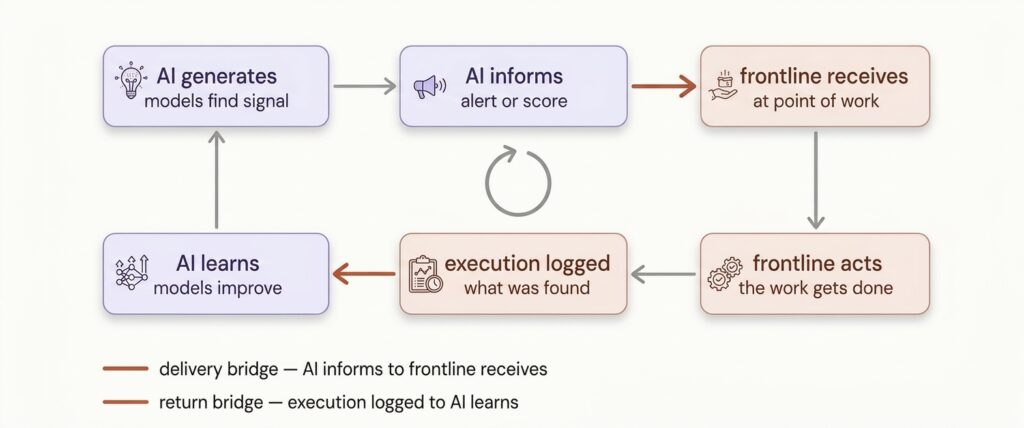
Investment and vendor attention has concentrated at the first two stages and the last. The middle three live on the floor, and they are usually assumed rather than designed. Better delivery produces more execution. More execution produces better data. Better data produces insights worth acting on.
The AI to action gap in practice
AI at BMW is well beyond the pilot stage. Plant Regensburg has spent roughly six years building AI-driven monitoring of conveyor technology, and today it covers about 80% of the plant’s main assembly lines. The system reads existing conveyor control data for irregular power draw, unusual movement, and barcodes that stop scanning cleanly. The approach has produced two patents and has been standardized for rollout to other plants.
When the system detects an anomaly, the maintenance control center receives an automatic warning message, which is assigned to the on-duty technician, who pulls the affected conveyor element for repair off the line. Between detection and resolution sits a manual step. A person reads the message, works out which element and which fault pattern, judges the urgency, and executes. That step governs response time. Response time is what converts a prediction into production that did not stop.
Regensburg alone avoids more than 500 minutes of vehicle assembly disruption every year, on a line where a finished vehicle comes off roughly every 57 seconds. The detection creates the value. The execution captures it.
BMW is now pushing on the execution seam. It is integrating recommended actions directly into fault messages to simplify troubleshooting and working toward estimating how much time remains between detection and stoppage so technicians can prioritize. Neither of those is a request for a better prediction. Both are requests for better support at the point of work.
Completing the AI to action loop
The technology exists today to bridge this gap and complete the AI to Action Loop. A frontline AI platform is the bidirectional operational layer for AI deployment. It can deliver intelligence into the flow of work, help workers act on that intelligence, automate appropriate processes and capture what happens as a result to continuously enhance AI insights. In the loop above, it occupies receive, act, and create-data. It does not replace the predictive maintenance vendor, the MES, or the digital twin. It carries their output to the worker, directs action and carries the result back. Key components include:
- Frontline user interface: A simple, accessible experience that puts information, workflows and AI assistance where work happens.
- AI in the flow of work: AI-powered guidance, recommendations, knowledge and decision support delivered in the context of the task.
- Process automation: Digital workflows that turn observations and recommendations into assignments, actions, escalations and follow-up.
- Closed-loop processes: Connecting the initial insight or issue through action, verification and resolution.
- Data capture and structured tagging: Turning observations, inspections, defects, images, decisions, actions and outcomes into usable operational data.
- Integration: Connecting frontline activity with enterprise applications, equipment and operational systems.
- Multifunction capability: Supporting multiple frontline processes through a common platform rather than creating another isolated application for every use case.
Manufacturing’s AI journey is moving beyond the question of “What can AI do?” As AI adoption accelerates, the focus will expand to “How do we maximize the impact of AI in our operations?” The answer is not solely more AI insights. It requires connecting AI intelligence with the people doing the work and capturing the intelligence generated by the work itself. A frontline digital platform creates an operational layer that makes that connection possible, allowing AI to become part of how work gets done while making the work itself a source of intelligence for further AI insights.

Ready to close your human-shaped blind spot?
See how ROO.AI digitalizes frontline work and puts AI at the point of activity.