


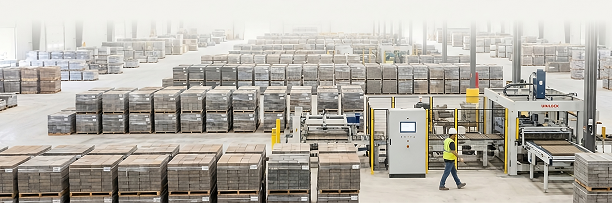
For more than fifty years, Unilock has been a leader in the North American hardscape market, manufacturing high-performance concrete pavers and walls that transform outdoor spaces. That leadership is built upon a reputation for consistent, reliable quality—every plant, every shift, every product. With operations spread across Canada and the U.S., achieving that consistency is an ongoing challenge. To address it, Unilock has been strengthening its total quality management approach and laying the groundwork for a more data-driven future.
At the Ayr, Ontario plant, Plant Manager Dan Buckland recognized a critical barrier: quality decisions still relied heavily on paper logs, operator experience and gut feel. To advance quality performance, his team needed a digital solution that was repeatable, measurable, and capable of delivering insights—not just documentation. That’s when Unilock turned to ROO.AI.
Operating on Experience and Gut Feel
Like many manufacturers, Unilock relied on skilled operators and paper-based processes to track quality on the production frontline. Quality checks on the “wet” side of the process were entered manually into their Microsoft ERP system, but the software was not designed to provide meaningful real-time insights into quality metrics. There was no clear indication of which checks were completed, whether results were within spec, or where issues were trending.
An initial attempt to digitize quality through spreadsheets proved unmanageable. “It was crazy complicated,” Dan recalls. “Someone would have had to babysit the system constantly, and even then, the data wasn’t very useful.”
On the “dry” side, where finished stones emerge from curing, defects were simply removed and scrapped. Scrap rates were within industry norms, but there was no mechanism for learning from those defects. Operators had theories about why certain stones failed, but no way to validate them. “Everyone knew defects were happening,” Dan explains. “Everyone had an opinion. But no one had the data.”

The result: missed opportunities for cost savings, inconsistent quality improvements, and no ability to systematically prevent recurring problems.
Going From Gut Feel to Digital Clarity

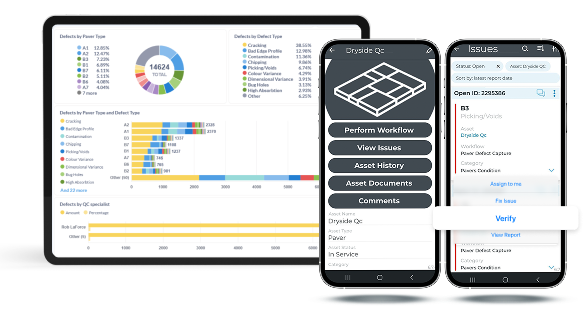
Dan partnered with the ROO.AI team to digitalize quality inspections in a way that frontline operators would actually use. The new digital quality process needed to be simple, visual, and fast—otherwise adoption would fail. Leveraging ROO.AI’s unique tap-and-swipe interface, the team built inspection workflows that mirrored the molds operators saw on the production line, allowing them to record multiple stone defects in seconds.
With ROO.AI, quality data is captured instantly and automatically compiled into a Daily Quality Scorecard. Management now reviews quality performance in real time, without hunting for paperwork, re-keying data, or waiting on spreadsheets to be updated.
The results during the pilot were immediate:
- “Wet” side quality scores increased by roughly 25%, stabilizing in the mid-90% range.
- On the dry side, scrap % dropped by almost 50% as operators used data to adjust press recipes and eliminate recurring issues.
- Instant visibility to automated reports provided daily time savings of 30 – 45 minutes of report preparation effort.
- Operator adoption was good. Initial skepticism from operators quickly disappeared. “They’re very grateful that we are fixing the problem that they’re having because it’s less work for them to have to pull bad stones off the line. So it’s been good for the operators all around,” said Dan
The shift was more than technological—it marked a quality culture transformation.
When Data Surpasses Art
With ROO.AI, Unilock now has a digital backbone for a data-driven quality culture. “QA is no longer ‘did we probably check it?’” says Dan. “It’s measured, trended, and visible.” Plant management has instant visibility to quality metrics. Teams can see defects by product and press, identify exactly where problems occur, and take corrective action quickly.
Real-time insight has replaced anecdotes and assumptions. Scrap reduction now translates directly into savings that boost the bottom line, while customers benefit from more consistent product quality.
Advice for Other Manufacturers
Dan and the Unilock team piloted the ROO.AI solution in three plants. Looking back, Dan offers some practical guidance:
- Start with a single pilot plant. Focusing on one location to refine the usability and workflows would have been faster, making it possible to roll out to other plants sooner.
- Don’t overcollect data. During the pilot, Dan cut fields that weren’t useful. The result was faster inspections and fewer data entry errors.
- Make usability a priority. “If it’s not easy, people just give up on it” Dan states.
His verdict on the ROO.AI pilot experience?
“From an idea to where it is now, it’s been very good. Everybody was very helpful along the way. Working with the company has been absolutely great.”


